What is EveryCircuit Apps?
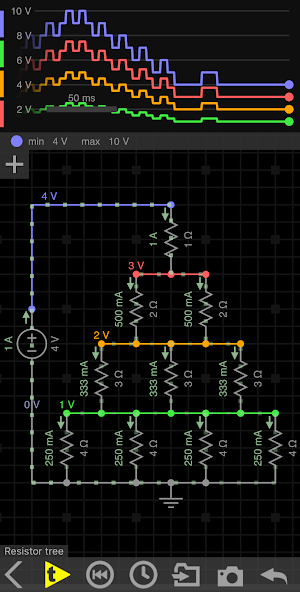
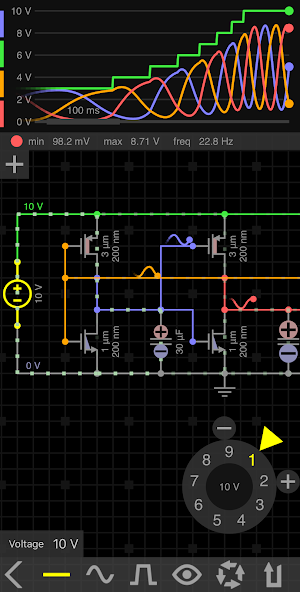
EveryCircuit Education is a learning-focused version of a real-time, interactive circuit simulation environment that helps learners visualize how electronic components behave and interact. It places emphasis on immediate feedback by allowing users to assemble circuits with familiar parts such as resistors, capacitors, inductors, diodes, transistors, operational amplifiers, sensors and power sources, then watching voltages and currents update dynamically as the system runs. Animated charge flow and live plots reinforce intuition about signal shapes, transient responses and steady state behavior without requiring manual calculation at every step. The interface encourages exploration through drag-and-drop construction, interactive knobs and parameter sliders that let students change component values on the fly and observe consequences in real time. For teaching, the platform supports creation of guided activities and demonstrations where educators can present a circuit concept, then step through stages of modification to illustrate cause and effect. For self-directed learners and hobbyists, the sandbox mode provides rapid iteration and experimentation, with measurement tools such as virtual multimeters and oscilloscopes that capture waveforms and numeric readouts. The balance between visual metaphors and quantitative outputs aims to bridge conceptual understanding with practical skill, helping beginners move from qualitative descriptions to hands-on analysis. By simulating transient and AC behavior, learners gain familiarity with topics like RC time constants, resonant circuits, amplifier frequency response and switching behavior. The focus on interactivity and immediate visual feedback makes EveryCircuit Education suitable for introductory courses, lab preparation, flipped classroom activities and independent study projects where experiential learning accelerates comprehension. Its approachable learning curve supports novices while offering adjustable fidelity for more advanced exploration, enabling iterative design, debugging practice, and development of mental models that transfer to physical prototyping and theoretical coursework across electronics, embedded systems, robotics and instrumentation domains, and supports varied assessment tasks, peer review, and portfolio creation for learning outcomes.
From a pedagogical perspective, EveryCircuit Education functions as an experiential learning tool that emphasizes active exploration, immediate feedback and progressive scaffolding. Lessons can be structured around inquiry prompts, hypothesis testing and iterative refinement, enabling students to form predictions, run experiments and compare expected results against simulated measurements. Built-in visualization and measurement features let learners collect waveform data, measure timing relationships and compute derived values, encouraging evidence-based reasoning and scientific methods in electronics learning. Educators can design sequences that gradually reduce guidance as competence grows, moving from highly scaffolded step-by-step tasks to open-ended design challenges that require synthesis of concepts. This progression supports mastery learning and differentiation: beginners focus on foundational concepts like Ohm’s law and simple RC transient behavior, while advanced learners explore non-linear device operation, feedback stability and frequency domain analysis. The platform also supports formative assessment through activity completion, recorded output traces and structured checkpoints that reveal common misconceptions such as confusing instantaneous current with average values or misreading phase shifts. Instructors can use these insights to adapt in-class discussions, design targeted remediation activities and emphasize modeling strategies that tie simulation behavior to analytical solutions. Collaborative features promote peer critique and shared problem solving, reinforcing communication skills and technical vocabulary as students annotate circuits and compare approaches. By lowering barriers to hands-on experimentation, the environment reduces time spent on setup and increases cycles of trial and reflection, which research links to deeper conceptual understanding. The simulated lab context is particularly useful for practicing hazardous or delicate experiments virtually, allowing students to explore failure modes and recovery strategies without physical risk, while building confidence before moving to hardware prototyping. Students who repeatedly test hypotheses within the simulator develop faster problem solving routines, improved circuit intuition, and a stronger sense of transfer when later confronted with unpredictability in physical builds.
Technically, EveryCircuit Education combines an interactive graphical interface with a computational engine designed to simulate circuit behavior in real time. The component library includes passive elements, standard semiconductor junctions, transistor families, operational amplifiers, digital logic primitives, AC and DC sources, meters and specialized measurement probes. The simulator computes transient and steady-state responses by numerically solving circuit equations, handling non-linear elements, state-dependent dynamics and frequency-dependent phenomena. Results are presented through synchronized animated element behaviors and high-resolution plots that display node voltages, branch currents and derived quantities like power and phase. Users can zoom into waveforms, measure time intervals and amplitude levels, and overlay multiple signals for comparative analysis. Advanced features include parameter sweeping to observe how varying a component value affects performance, frequency response sweeps to reveal Bode characteristics, and basic spectral analysis for harmonics and distortion inspection. For design workflows, circuit snapshots can be duplicated, modified and compared, supporting iterative refinement and versioning of ideas. Export options cover image captures and structured data exports of waveform traces, facilitating inclusion in lab reports and documentation. The computational model balances responsiveness with numerical stability, applying adaptive time-stepping and specialized solvers to maintain accuracy without sacrificing interactive rates. While the environment prioritizes educational clarity and usability, it still provides realistic device behaviors that illustrate saturation, clipping, hysteresis and thermal-like effects for certain models, helping learners connect simulated dynamics to physical expectations. Integration of scripting and macro-like controls allows repeated experiment automation and reproducible demonstrations. Overall, the platform seeks to give learners and instructors a technically capable sandbox where conceptual exploration, quantitative measurement and iterative design converge within a responsive, visually intuitive simulation experience. It supports layered complexity so beginners can hide advanced options while advanced users expose detailed parameters like model tolerances, temperature effects, and behavioral component expressions for deeper investigation and diagnostics.
From a user experience standpoint, EveryCircuit Education prioritizes clarity, immediate visual feedback and hands-on manipulation to make abstract electrical concepts tangible. The canvas allows direct manipulation of components using intuitive gestures and simple wiring flows, with clear labels and contextual tooltips that reduce cognitive load for novices. Visual metaphors such as animated charge movement, color-coded voltage gradients and dynamic component shading provide continuous, glanceable cues about operating conditions and signal polarity. Measurement and annotation tools let learners mark points of interest on waveforms, attach notes to components and export labeled screenshots for reports or presentations. Accessibility considerations include adjustable color palettes, scalable UI elements and keyboard shortcuts that accommodate diverse learners and workflow preferences. The environment supports experiment pacing by letting users pause simulation time, step through events frame by frame, or replay traces to analyze causality in complex interactions. Collaboration features enable sharing circuit files, embedding annotated examples in course materials and conducting peer review activities where students critique designs and suggest improvements. Practical learning sequences often use starter templates, progressive checkpoints and challenge prompts that nudge learners toward design constraints such as size, power budget, or component availability, encouraging realistic engineering trade-offs. For makers and competition teams, the tool accelerates concept validation and early-stage troubleshooting before hardware assembly. Community-curated libraries of example circuits and exemplar solutions inspire exploration while serving as reference points for common patterns like filter topologies, amplifier biasing or comparator hysteresis circuits. Overall, the UX emphasizes making experimentation rapid, feedback-rich and low-friction so that curiosity, troubleshooting and iterative refinement drive deeper learning rather than interface friction. The design supports incremental complexity, offering templates for guided discovery, challenge modes for timed problem solving, and exportable assessment artifacts that teachers can incorporate into grading rubrics or reflective portfolios to document learning progression and encourage iterative feedback cycles.
EveryCircuit Education serves a broad audience that ranges from high school science classes and technical vocational programs to undergraduate electrical engineering courses, hobbyist makers and interdisciplinary teams in robotics and embedded systems. For introductory classrooms it distills essential concepts into manipulable experiments that accelerate the transition from memorization to applied understanding. Technical programs use it to prepare students for laboratory work by letting them rehearse measurement techniques, identify likely failure modes and refine wiring practices virtually before dealing with hardware time constraints. Makers and early-stage designers benefit from rapid prototyping workflows that let them validate circuit architectures, test interface ideas and iterate quickly on component choices. The platform also supports capstone and project-based learning by enabling reproducible demonstrations, versioned designs and annotated deliverables that convey design intent and verification evidence. Benefits include increased experimentation density, clearer links between theory and practice, and opportunities for formative feedback through traceable simulation artifacts. There are practical limits: very high-frequency RF systems, complex multi-physics interactions and some specialized components may require more detailed professional tools or physical measurement to capture all real-world subtleties. Consequently, the simulator works best as part of a balanced curriculum where conceptual learning, simulation-based verification and hands-on prototyping form complementary stages of development. Educators and learners often pair simulated experiments with guided reflection prompts, comparative lab exercises and checkpoints that require translating simulated results into physical measurement plans. Over time, repeated cycles of virtual testing and physical implementation build transferable troubleshooting skills and reduce iteration costs during hardware builds. Ultimately, EveryCircuit Education acts as an accessible bridge between conceptual instruction and practical design, helping learners gain confidence, sharpen diagnostic reasoning and prepare for increasingly sophisticated electronics challenges. Users report improved lab readiness, debugging cycles and a stronger record of documented experiments that support assessment and accreditation evidence in technical programs.


 HappyMod