What is Mini Metro Games?
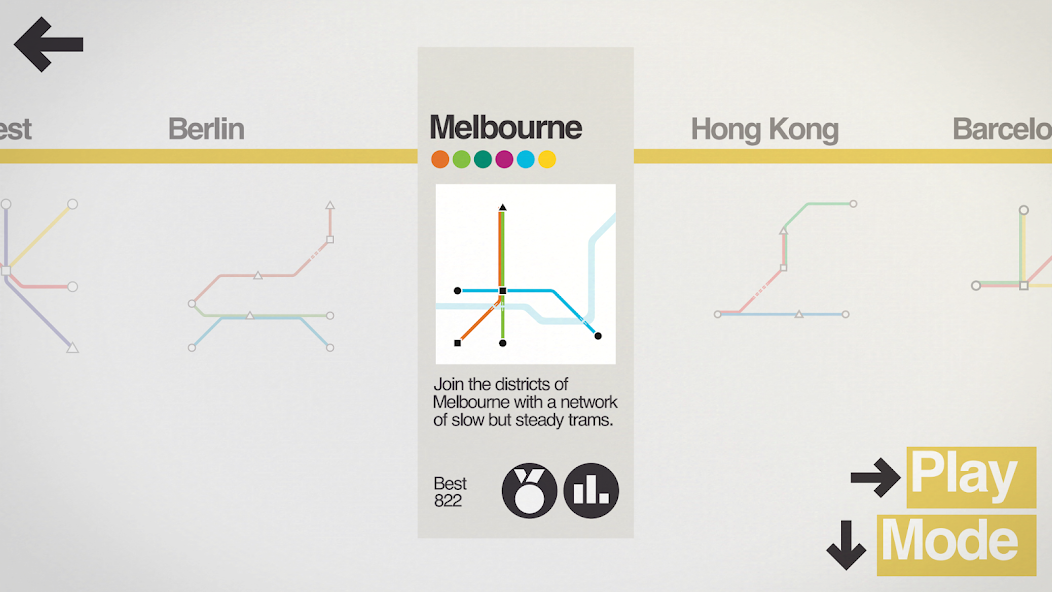
Mini Metro is a minimalist strategy and simulation game that places players in the role of a transit planner tasked with designing and managing subway networks for growing cities. The core mechanic revolves around drawing lines between stations and allocating a limited number of trains to move passengers efficiently. Stations generate colored passengers that need to be transported to stations of matching color, creating constant demands that test routing efficiency and adaptability. As the city evolves, new stations appear, passenger numbers increase, and occasional special events introduce challenges such as river crossings that require tunnels or extra resources. Players must balance expansion with maintenance, deciding whether to add carriages, tunnels, or extra lines while keeping service smooth and avoiding overcrowding. Gameplay sessions are structured into short, carefully balanced levels that emphasize thoughtful planning and graceful failure; when any station becomes overcrowded the run ends, encouraging players to learn from mistakes and try new strategies. The visual design is intentionally restrained, using simple geometric shapes and a clean, readable map layout that highlights flow and function over ornate aesthetics. Sound design complements this minimalism with a calming ambient soundtrack and subtle mechanical cues that reflect the city’s pulse. Difficulty scales organically, offering both relaxed runs for newcomers and more demanding scenarios for experienced players who seek optimization and high scores. Despite its straightforward ruleset, the emergent complexity of managing multiple lines and passenger flows leads to deep strategic gameplay and a satisfying sense of mastery as small routing decisions ripple across the entire network. The game includes a variety of city maps inspired by real-world transit systems, each with unique geography and constraints that change strategic priorities. A challenge mode and daily puzzles encourage short, focused sessions, while sandbox tendencies invite experimentation and long-term optimization for players who enjoy iterative design.
Mini Metro’s visual language is characterized by its economy and clarity, favoring simple shapes, limited color palettes, and readable typography to convey complex transit information at a glance. Stations are represented as geometric dots and nodes, while lines are rendered as clean colored paths that remain easily distinguishable even on dense networks. This reductionist approach reduces cognitive load, allowing players to focus on system behavior rather than decorative details. Color choice and contrast are used deliberately to signal destination matching and line separation; animations are subtle but informative, indicating train movement, passenger boarding, and congestion without overwhelming the display. The user interface maintains the same minimal ethos: menus are unobtrusive, tooltips are concise, and controls emphasize direct manipulation, such as drawing and deleting lines with simple gestures or clicks. Audio complements visuals through an ambient soundtrack that adapts to the pace of play, using sparse electronic motifs that provide rhythm without intrusion. Sound effects serve as functional cues — small chimes for successful transfers and softer warnings for growing queues — and can be adjusted or muted in options for players with different preferences. Accessibility considerations include scalable elements that remain legible at various resolutions and color combinations that typically avoid problematic pairings, though players with specific color vision needs may benefit from additional customization. The overall presentation frames the simulation as a living diagram; aesthetic choices reinforce the conceptual clarity of the transit model while creating a calm, contemplative atmosphere. This makes the game approachable for players who appreciate thoughtful, puzzle-like challenges as well as for those seeking a relaxing diversion. Because every element — visual, auditory, and interactive — is designed to support comprehension and strategic thinking, the game's minimalist style feels purposeful rather than sparse. Small tutorials and adjustable difficulty let more players learn and improve gradually.
Strategy in Mini Metro centers on efficient resource allocation and anticipating future demands as much as reacting to immediate imbalances. Early decisions shape mid- and late-game viability: creating looped lines can provide redundancy but may waste trains if demand is concentrated; straight trunk-and-branch lines excel at moving high volumes along a main corridor; and short feeder routes can relieve pressure on busy hubs. Prioritizing upgrades requires judgment — adding carriages increases capacity where trains are busiest, tunnels allow crossing geographic barriers that otherwise force long detours, and additional trains expand throughput but consume allocation that might be needed elsewhere. Observant players track passenger queues and travel patterns, rerouting lines proactively to prevent bottlenecks and splitting overloaded lines into parallel services when colors cluster. Flexibility in design is critical because station placement evolves unpredictably, so leaving space in your map for new lines and avoiding overly long single-line dependencies reduces the risk of catastrophic congestion. An effective approach balances direct routes for popular pairs of stations with cross-connection options that reduce transfer loads. Time management matters too: during peak arrival waves, quick, incremental adjustments outperform massive rewrites that temporarily interrupt flow. Challenge modes and daily scenarios sharpen specific skills by imposing constraints such as limited tunnels, irregular geography, or faster passenger growth, encouraging creative problem solving under pressure. Replayability emerges from the procedural variety; even familiar cities require fresh strategies when different station distributions or event timings occur. Players seeking depth can pursue high-score optimization, experimenting with micro-adjustments, or treat the game as a meditative exercise in improving incremental efficiencies. Recording runs and analyzing failure points helps refine heuristics: identify recurring chokepoints, test whether a new line relieves demand, and learn when to prioritize redundancy over directness. These strategic layers give Mini Metro a satisfying tension between tidy planning and improvisation.
Mini Metro is designed with a lightweight technical footprint that emphasizes smooth performance and responsive controls across diverse hardware configurations. The core simulation runs efficiently because of minimalistic graphics and optimized pathfinding logic, allowing fluid gameplay on desktop systems, tablets, and portable devices with modest CPU and GPU capabilities. Input paradigms are tailored to each platform: click-and-drag or touch gestures for drawing and editing lines, simple tap interactions for selecting stations, and keyboard shortcuts for quick actions on traditional computers. Frame rate stability and low latency are prioritized to keep train animations and passenger updates coherent even when networks grow complex. Save systems typically preserve single-session progress and support replaying past runs for study, while settings let players adjust audio levels, visual scaling, and control sensitivity to match personal preferences or accessibility needs. The deterministic nature of the procedural generation means similar starting conditions can be reproduced, making comparative experiments and strategy testing feasible. Because the game avoids heavy asset streaming and relies on vector-like rendering, load times are minimal and memory usage remains conservative. Multiplayer elements are not the focus; instead, the experience centers on solitary problem solving, short challenge runs, and score-based leaderboards that encourage competition through performance rather than synchronous play. Regular small updates have historically refined balance, added city maps, and addressed platform-specific issues to maintain a polished experience. Developers have taken care to expose settings and informative feedback onscreen so players can diagnose why certain stations are failing and iterate on designs. The combination of simple aesthetics and robust under-the-hood engineering results in a game that is accessible to newcomers while providing precise control for players who enjoy squeezing out incremental improvements from their transit networks. Modding and community scenarios add variety, with custom city maps and altered rules that extend replay value and creativity.
Mini Metro appeals to a broad audience because it blends accessible mechanics with layered strategic depth that rewards both casual players and puzzle enthusiasts. Its emphasis on systems thinking teaches transferable skills: pattern recognition, trade-off analysis, capacity planning, and incremental problem solving under constraints. Players practice prioritization as they decide which bottlenecks to relieve and which investments will yield the best marginal gains, an exercise similar to basic operations planning. The short-session format and clear failure conditions make the game suitable for bite-sized play, while the satisfaction of a long, well-managed run provides a sense of accomplishment for those who prefer extended focus. Comparatively, Mini Metro sits comfortably between relaxed puzzle titles and more simulation-heavy transport management games, offering a distilled transit design experience without the administrative overhead of larger management simulations. It is well-suited for use in casual learning contexts and informal educational settings where demonstrating urban flow dynamics or resource allocation principles can be engaging and intuitive. Community-driven challenges and leaderboard competitions create optional social hooks without forcing multiplayer interactions, enabling friendly rivalry centered on efficiency rather than reflexes. Over time, the game encourages iterative improvement: players refine heuristics, discover emergent patterns, and internalize effective layouts that can be applied across different maps. The modest visual style contributes to longevity by remaining timeless and focused on utility rather than flashy trends that date quickly. For many, Mini Metro becomes a sandbox for elegant problem solving, a compact design studio where small changes have meaningful systemic effects. Whether someone plays to relax, to study network behavior, or to chase high scores, the title offers a satisfying blend of clarity, challenge, and replayability that keeps sessions fresh and mentally engaging. Its short learning curve makes it accessible to older children and adults while depth supports experienced strategists seeking enduring challenge.
How to Get Started with Mini Metro?
- 1. **Download and Install**: Get Mini Metro from the official website or a trusted platform like Steam or mobile app stores.
- 2. **Choose a Mode**: Start with the main mode (New York, London, etc.) to familiarize yourself with gameplay.
- 3. **Understand the Basics**: Learn the mechanics—drawing lines, placing trains, and managing stations.
- 4. **Draw Routes**: Connect stations intuitively, aiming for efficiency and passenger satisfaction.
- 5. **Expand Carefully**: Add new lines and stations strategically to avoid overcrowding.
- 6. **Use Upgrades Wisely**: Choose upgrades (like more trains or tunnels) based on your current network needs.
- 7. **Monitor Passenger Load**: Keep an eye on stations to prevent overcrowding and ensure timely service.
- 8. **Plan for Growth**: Anticipate demand changes as new stations appear and adjust routes accordingly.
- 9. **Experiment with Strategies**: Try different approaches to routes and upgrades for better results.
- 10. **Practice Regularly**: Play frequently to improve your skills and learn from past mistakes.
10 Pro Tips for Mini Metro Users
- 1. Plan Your Routes: Before expanding, analyze the map for optimal connections between stations to minimize travel time.
- 2. Prioritize High-Demand Stations: Focus on connecting and upgrading stations that frequently fill with passengers to prevent bottlenecks.
- 3. Use Different Transport Types Wisely: Switch between trains, trams, and ferries according to the map layout and station needs for efficient movement.
- 4. Maintain Balanced Infrastructure: Avoid overcrowding a single line; distribute traffic across multiple lines to keep the system flowing smoothly.
- 5. Expand Strategically: When adding new lines, consider the overall flow and try to connect new stations to existing routes rather than starting from scratch.
- 6. Monitor Passenger Behavior: Pay attention to the types of passengers waiting; adjust your lines to accommodate their needs and reduce wait times.
- 7. Upgrade Lines Judiciously: Focus on improving lines that serve high-traffic areas before expanding into less populated regions.
- 8. Keep an Eye on Station Capacity: Upgrade stations and add trains when they consistently approach full capacity to avoid delays.
- 9. Save Resources for Emergencies: Keep extra trains or carriages in reserve to deploy quickly when stations start to overcrowd.
- 10. Experiment with Line Colors: Use contrasting colors for different routes to help keep the system organized and easily navigable for players.
The Best Hidden Features in Mini Metro
- **Dynamic City Growth**: The city layout evolves over time, with new stations appearing based on your network's efficiency and needs.
- **Unique Station Types**: Certain stations require specific train types or have unique demands, adding complexity to your strategy.
- **Custom Graphics Options**: Players can unlock alternative art styles and themes, providing a fresh aesthetic experience.
- **Soundtrack Changes**: The soundtrack adapts to the pace and intensity of gameplay, enhancing the atmosphere during frantic moments.
- **Daily Challenges**: Special scenarios and objectives are offered daily, encouraging replayability and varied gameplay experiences.
- **Multiplayer Mode**: Team up with friends to build a metro system collaboratively, emphasizing coordination and shared planning.
- **Undo Function**: Mistakes can be rectified with an undo option, allowing players to experiment without permanent consequences.
- **Achievement System**: Hidden achievements motivate players to explore different gameplay styles and strategies.


 HappyMod