What is Papers, Please Games?
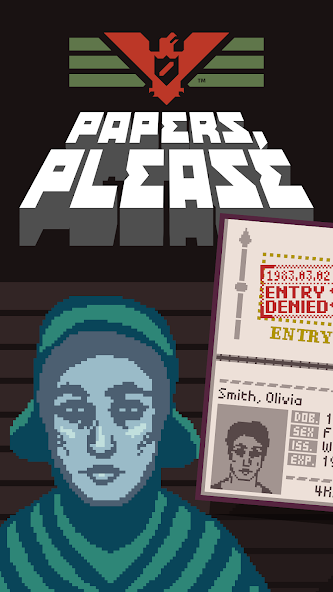
Papers, Please is an independent video game created by Lucas Pope that simulates the routine work of an immigration inspector at a fictional border checkpoint in the authoritarian state of Arstotzka. Players assume the role of a newly appointed inspector who must check documents, verify identities, and decide whether to admit, detain, or deny entry to travelers. The gameplay revolves around detailed inspection mechanics: passports, entry permits, work passes, vaccination certificates, and other papers must match official guidelines that change daily. The player uses a simple interface to stamp documents, inspect for discrepancies, and interrogate suspicious applicants. Correct decisions earn wages necessary to support the inspector's family while mistakes or missed violations lead to fines and consequences. Beyond mechanical checks, Papers, Please layers moral dilemmas and human stories within its procedural structure. Characters arriving at the booth present urgent personal circumstances, such as families seeking reunion, refugees fleeing danger, or smugglers disguising contraband. Players wrestle with the tension between following orders and responding to human need, because bending rules can help individuals but risks penalties from supervisors and the state. The game unfolds across multiple in-game days, with narrative branches and endings determined by the player’s choices and accumulated actions. Visual presentation uses a stark, retro aesthetic that evokes Cold War-era bureaucratic bleakness and emphasizes the repetitive, grindlike nature of the position. Sound design supports this atmosphere with ambient office noise, synthetic tones, and voice snippets that enhance immersion. Papers, Please is notable for transforming administrative labor into meaningful gameplay, using procedural systems and moral weight to interrogate themes of authority, empathy, and survival. Players often describe the experience as challenging and emotionally affecting, because small clerical choices accumulate into stark personal consequences that force reflection on how systems shape behavior and how ordinary people cope under oppressive bureaucratic regimes.
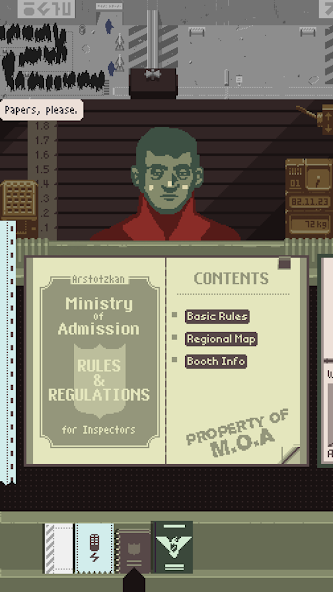
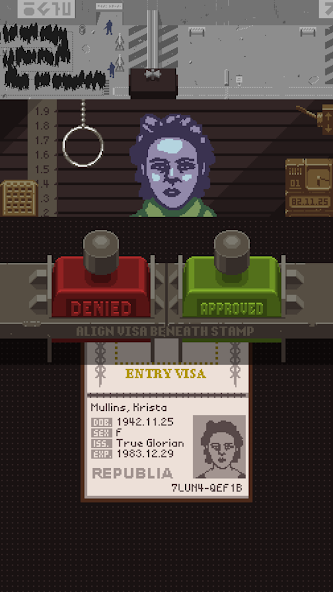
Papers, Please uses rules and paperwork as its core mechanics, turning document verification into a puzzle system where attention to detail is rewarded and routine can become increasingly complex. Each in-game day begins with a rulebook update and a list of required documents that shift to reflect new regulations, political changes, and emergency directives. Players must compare names, dates, issuing cities, expiry dates, photographs, seals, and stamps, while monitoring a limited set of tools like a passport inspector, a rules booklet, and a simple dialogue interface. Timing matters because each day has a quota of applicants and a finite amount of time, creating pressure to work quickly without sacrificing accuracy. Fines are issued for errors or missing violations, which deplete the money needed for rent, heat, food, and medicines for the inspector’s family. Payment decisions force players to prioritize which mistakes they can afford and when to take risks to help someone in need. The game introduces more complex document types and exceptions over time, such as diplomatic passports, work permits, and sealed crates, along with inspectors from other agencies who enforce different standards. Random events and scripted encounters keep the experience unpredictable: confrontations with smugglers, requests for bribes, resistance activities, and moral dilemmas appear and demand immediate judgement under procedural constraints. The interface deliberately mimics bureaucratic forms, with clunky menus and a clipboard aesthetic that reinforces the joblike rhythm of the work. Success in Papers, Please depends on learning the rules, developing scanning habits to spot inconsistencies, managing stress and speed, and choosing which human stories to prioritize when regulations and compassion collide. The balance of escalating complexity, limited resources, and moral ambiguity defines much of the game’s tension and replay value. Players can experiment with different approaches to discover multiple endings and emergent story variations often across playthroughs.
Papers, Please functions as a commentary on bureaucracy, power, and the human cost of administrative systems, using gameplay as a rhetorical device to prompt reflection rather than delivering explicit moralizing. The fictional nation and its shifting policies provide a backdrop for exploring how ordinary people respond to coercive institutions, and the game deliberately frames choices so consequences feel ambiguous and meaningful. Through short vignettes, the narrative explores the lives of migrants, dissidents, and everyday citizens whose needs collide with cold regulations, which creates moments of empathy and cognitive dissonance. The inspector’s family introduces domestic pressure that personalizes the stakes, connecting ostensibly abstract ledger entries and stamps to real human needs like heat or medicine. This anchoring encourages players to weigh personal survival against professional duty, and the multiplicity of endings reflects the ethical complexity of those decisions rather than presenting a single correct path. Artistically, the pixelated, utilitarian visuals and constrained color palette evoke a sense of scarcity and severity that supports the game’s themes, while sound cues and brief voice samples add emotional weight to interactions without overwhelming the procedural feel. Critics and scholars have praised the game for its ability to make administrative labor visible, turning repetitive tasks into a medium for storytelling and critique. That approach resonates with players who find the slow accumulation of small actions compelling and sometimes uncomfortable, since the game makes complicity and consequence a daily routine. Papers, Please also invites discussion about obedience, resistance, and the quotidian mechanisms of control, encouraging players to consider how paperwork and protocol can enforce or subvert power. The work remains influential as an example of how indie games can combine mechanics, narrative, and aesthetics to engage players in reflective, morally nuanced experiences. It rewards patient observation and often lingers in the player’s memory long after play.
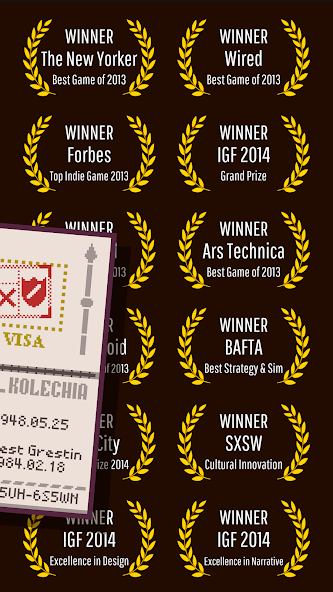
Papers, Please was developed almost entirely by Lucas Pope, an independent designer and former console game developer whose prior experience influenced the game’s craft and attention to interface. The project began as an exploration of mundane systems turned into interactive challenges, and small, iterative design choices refined the balance between mechanic and message. When it released, the game drew attention for its unusual subject matter and concise execution, receiving praise from critics and players for its originality and emotional resonance. It earned awards and nominations across independent game festivals and major industry outlets, and its success helped demonstrate that minimalist presentation, focused mechanics, and mature themes could reach broad audiences. Reviewers highlighted the game’s capacity to provoke thought and discussion about civic institutions and moral responsibility, while award juries recognized its design innovation and narrative integration. The game’s modest scale also made it accessible for scholarly analysis and teaching, appearing as a case study in courses about game design, ethics, and interactive storytelling. Lucas Pope continued to work on experimental projects that emphasize strong, singular ideas realized through careful mechanical systems, and Papers, Please became a defining entry in his portfolio. Its influence can be seen in later indie titles that use bureaucratic or mundane labor as a core gameplay loop, and in a wider acceptance of games as vehicles for social critique. The development story underscores how limited resources and focused vision can produce culturally significant work when mechanics and message align. For many players, Papers, Please stands as an example of how interactivity can make political subject matter personally immediate, converting policy into palpable human consequence through the slow work of stamps, checks, and small decisions. The game’s compact structure encourages replay, experimentation, and discussion among players who value narrative-driven systemic design. It remains studied and celebrated widely.
Papers, Please appeals to players who enjoy methodical puzzles, moral complexity, and narrative consequence, and it finds audiences among both traditional gamers and those interested in political storytelling. The game’s learning curve emphasizes observation and pattern recognition rather than reflexes, making it approachable for players focused on deliberation and incremental mastery. Replayability stems from branching events, multiple endings, and emergent narratives created when players prioritize different goals such as family welfare, ideological alignment, or resistance. The title has been used in academic discussions, streamed on video platforms where viewers debate choices in real time, and included in collections of games that challenge conventional entertainment paradigms. While the interface is intentionally austere, optional gameplay variations and community-created content have extended the title’s life by introducing new scenarios, challenges, and interpretive frameworks. Accessibility considerations, such as clear typography and predictable rules, support play by a wide demographic, though the game’s emotional intensity and bleak setting may not appeal to everyone. Players who appreciate slow-building tension and ethical tradeoffs will find the experience rewarding, while those seeking fast action or lighthearted stories may prefer other genres. The game also sparked conversations about how games can model bureaucracy and accountability, and it inspired creators to experiment with similar approaches that make mundane labor narratively significant. For players and educators, Papers, Please offers fertile ground for exercises in decision-making, empathy, and systems thinking, because each session compresses governmental processes into tangible, interactive tasks. Many players recount strong personal stories about choices they made, and community discourse often examines how small protocols produce large social effects. It remains central to conversations about games and governance.
 HappyMod