What is Townscaper Games?
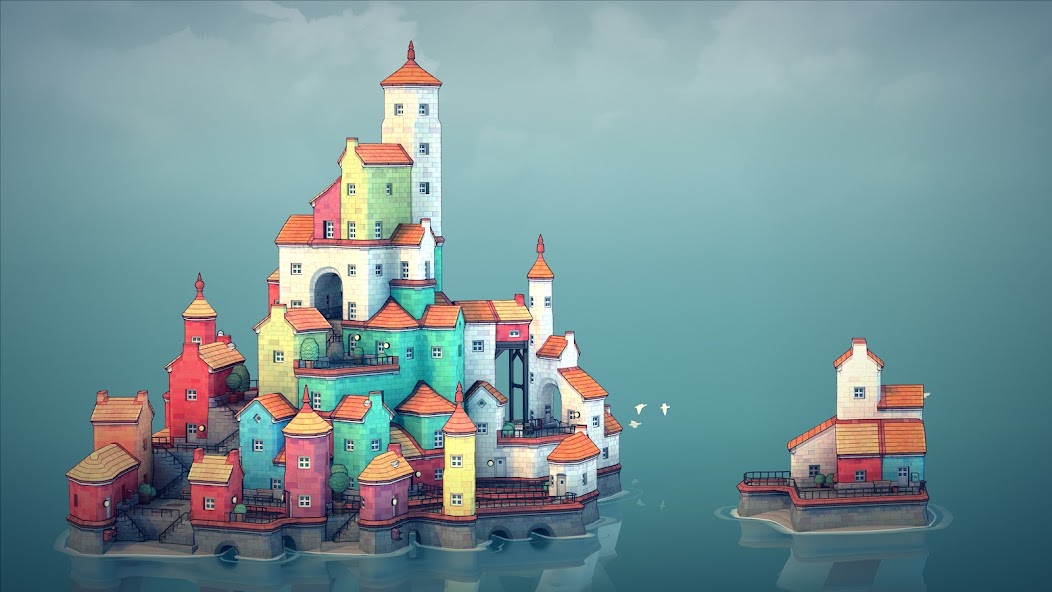
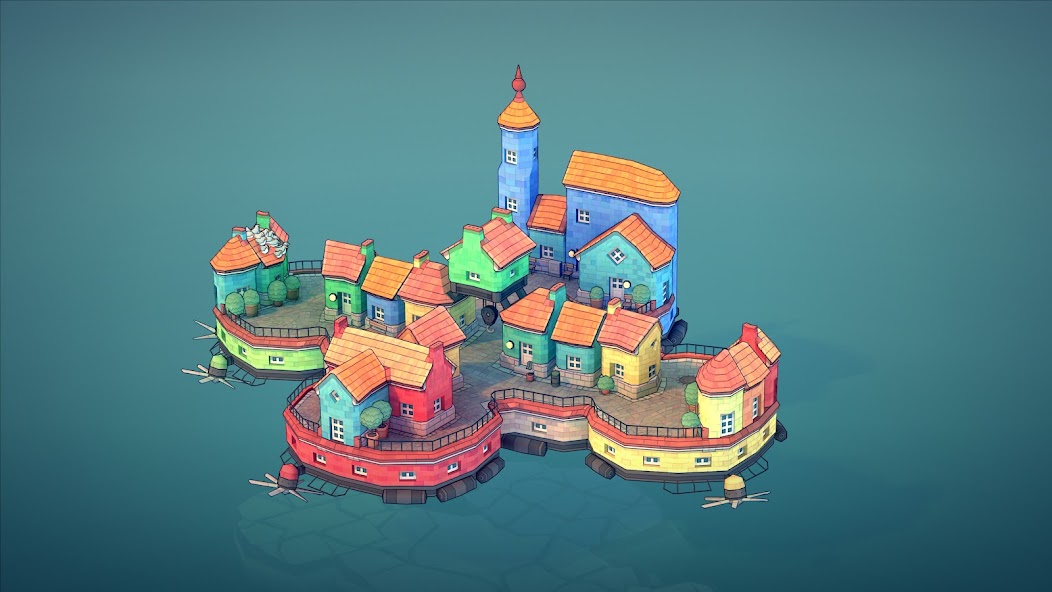
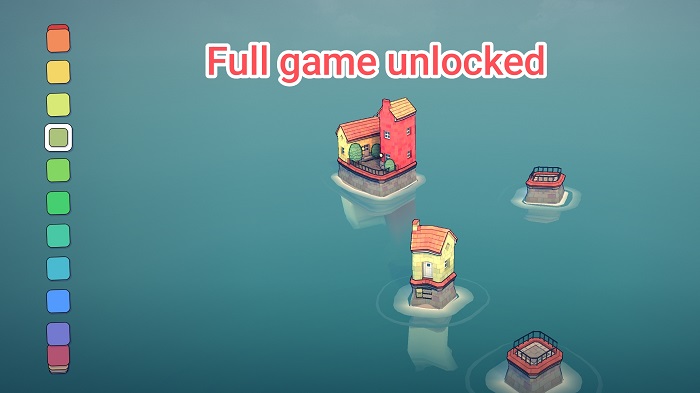
Townscaper is a minimalist building toy rather than a conventional game, inviting players to construct charming island towns by simply clicking or tapping on a grid of hexagonal tiles. The interface is intentionally spare: there are no missions, timers, resource meters, or failure states; instead the experience focuses on immediate creative feedback and visual harmony. Each placement triggers an algorithm that extends walls, adds arches, staircases, rooftops, and balconies according to local geometry, producing coherent architecture that often looks hand designed despite being procedurally generated. Color choices are limited but expressive, and toggles for water level or building density let players shape both skyline and shoreline with effortless gestures. Because actions are reversible and the environment regenerates textures and decorative details on the fly, experimenting feels risk free and playful; accidental placements can be smoothed or built upon, inviting iterative exploration of forms. The game encourages spontaneous composition: a few decisions cascade into surprising structural rhythms, while symmetry and contrast emerge from simple repetitions of the same tool. Ambient sound and minimalist chimes punctuate building actions, enhancing the meditative tempo without imposing direction. For people who enjoy pattern recognition, spatial reasoning, or low pressure creative play, Townscaper offers a compact laboratory where visual ideas can be tested quickly and enjoyed purely for their aesthetic outcome. It operates equally well as a short calming diversion or as the beginning of long, elaborate villages, and its lack of goals reframes success as the act of making itself. Players often share screenshots to celebrate striking color combinations and inventive silhouettes, and many return again and again to refine motifs, develop waterfronts, or experiment with seasonal palettes; the compact toolset supports both spontaneous doodles and deliberate study of architectural proportion, making each session a small design exercise regardless of prior building experience and delight.
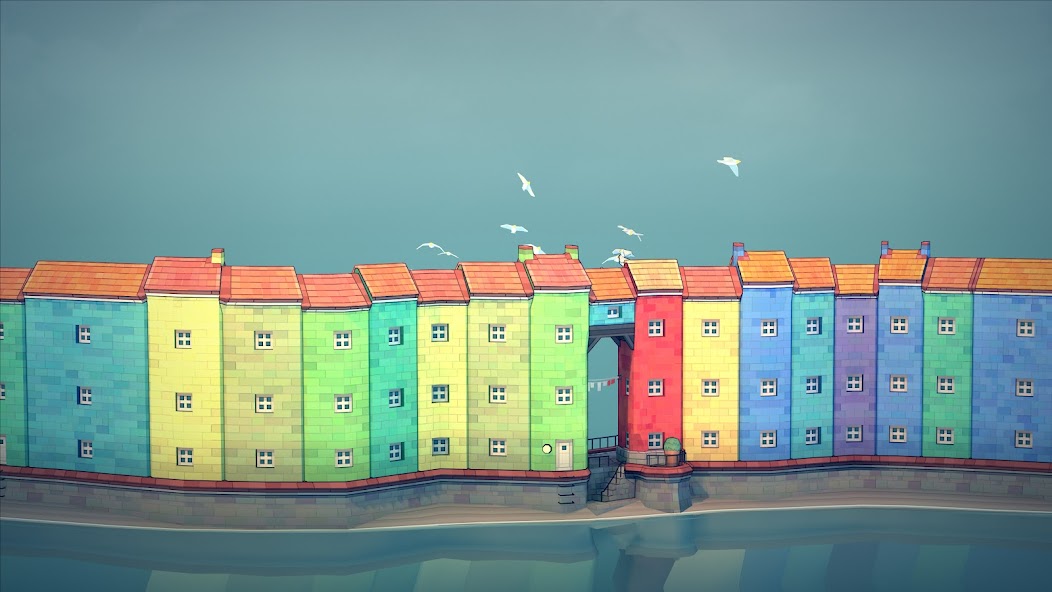
At the heart of Townscaper's appeal is a distinct visual and auditory aesthetic that blends simple geometry with saturated, almost toy-like colors and gentle ambient music. The game's tiles, arches, and roofs are rendered with soft shading and subtle gradients, giving buildings a tactile, painted quality that invites inspection. Limited palettes—pastel blues, terracotta reds, warm yellows, cool grays—encourage compositions that feel cohesive, while contrast between roof shapes and façade details produces pleasing architectural silhouettes. Lighting is static but flattering, and reflections on water tiles add an extra layer of depth without complicating the scene. The soundtrack is composed of sparse melodic motifs and calming textures that respond to building actions with light chimes, creating a feedback loop that reinforces relaxed creativity. Together, visuals and sound reduce cognitive friction and orient players toward flow states; the interface disappears and the act of placing geometry becomes its own reward. Accessibility features are baked into the simplicity: color contrast is usually strong, controls are mouse- and touch-friendly, and the pace is entirely player driven, so the experience accommodates a wide range of abilities and preferences. Because the aesthetic leans away from realism, players can focus on composition, rhythm, and balance rather than precise measurements or simulation fidelity. The art direction deliberately evokes memories of seaside towns and Mediterranean harbors while remaining abstract enough to support other stylistic interpretations, such as blocky modernism or whimsical fairy-tale clusters. This balance between familiarity and abstraction makes Townscaper visually inviting, emotionally comforting, and remarkably versatile as a canvas for personal expression. Artists and hobbyist designers often use Townscaper as a quick sketch tool to test color harmonies and massing ideas; its compact output can be exported as images to document progress, to include in mood boards, or simply to preserve satisfying arrangements for later reinterpretation and study.
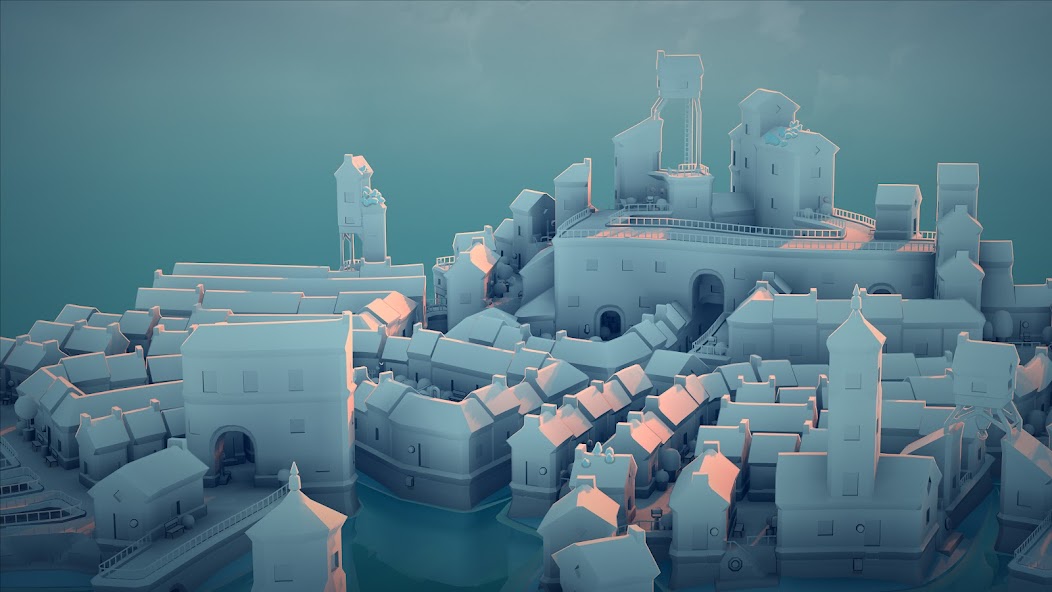
Behind Townscaper's deceptively simple interface lies a compact procedural system that maps player input to architectural primitives through a set of local rules and pattern matching. When a tile is toggled, the algorithm inspects neighboring tiles and applies heuristics to determine wall continuity, corner chamfers, window placements, and roof segments, producing structures that obey implicit grammar rather than explicit blueprints. This local-rule approach reduces computational complexity and yields emergent forms: repeated placements create recognizable motifs while edge cases are handled by fallback rules that prioritize visual coherence. Rendering is lightweight, favoring precomputed geometry variations, texture tiling, and efficient draw calls so that even dense towns remain responsive on modest hardware. Many implementations use an engine capable of handling dynamic mesh updates and simple particle or reflection effects, while physics simulation is intentionally absent to keep interactions deterministic and performance predictable. Save data tends to be compact, storing tile states and color palettes rather than full meshes, which enables quick serialization and small file footprints. The design also supports easy iteration: tweaking a few parameters in the generation rules can produce markedly different architectural styles or densities without rewriting core systems. Some technical versions expose APIs or editors for artists to experiment with the rule set directly, enabling procedural artists to prototype new ornamentation or roof logic. From a software engineering perspective, Townscaper exemplifies how rule-based procedural content can deliver rich visual variety with a small codebase and modest resource demands, making it an instructive example for developers interested in generative design, lightweight rendering techniques, and user-driven content systems. Independent creators study Townscaper's approach as a teaching example, reproducing simplified rule engines in tutorials, writing code snippets that demonstrate neighbor-based decisions, and adapting ideas into procedural city experiments, thereby spreading practical knowledge about compact generative algorithms across design and developer communities.
Townscaper's open-ended, low-pressure structure makes it especially suited for educational and therapeutic contexts where creativity, relaxation, and observational learning are priorities. In classroom settings, it can be presented as a visual sandbox to introduce basic architectural concepts—such as massing, repetition, rhythm, and skyline composition—without requiring technical drawing skills, enabling students to explore proportion and contrast through direct manipulation. Its instant feedback loop and absence of punitive mechanics reduce anxiety and promote experimentation, which supports creative problem solving and divergent thinking. Therapists and wellness practitioners have noted that the game's repetitive building actions, gentle audio cues, and predictable rule responses can facilitate calming routines and mindful focus, similar to coloring or simple puzzle tasks. Because sessions can be as short or as extended as needed, Townscaper adapts to attention spans across age groups and cognitive needs; it can form part of short grounding exercises or be used as a longer reflective activity. The tool also supports collaborative exercises: groups can co-create themed neighborhoods, trade design constraints, or critique balance and color choices as a means of developing communication and critical observation skills. For learners in digital art and game design programs, the game demonstrates how minimal controls and procedural logic produce aesthetically rich outcomes, prompting discussions about systems thinking, user experience, and the balance between randomness and structure. Educators who incorporate the title often pair it with sketching tasks, photo documentation, or short reflective prompts that encourage students to articulate design choices, thereby translating playful exploration into concrete learning outcomes. Moreover, Townscaper can be integrated into interdisciplinary lessons that connect geography, history, and literature by asking learners to recreate historical harbors, imagine fictional settlements, or study coastal erosion visually; such projects foster research, narrative thinking, and spatial empathy while keeping the emphasis squarely on hands-on creative exploration rather than technical proficiency.
Townscaper has inspired an active creative community that celebrates both casual snapshots and ambitious compositions, with players sharing screenshots, time-lapses, and themed collections that explore different palettes, densities, and architectural motifs. Social spaces host friendly challenges—such as seaside cathedral contests, floating market prompts, or monochrome experiments—that encourage invention within simple constraints and generate surprising diversity from the same toolset. Artists and hobbyists remix Townscaper outputs into larger projects, incorporating rendered towns into collages, tabletop terrain concepts, or animated sequences, while photographers and graphic designers use exported images as backdrops or texture studies. Because the game emphasizes composition over simulation, entries span a spectrum from tightly organized grids to chaotic, organic clusters, demonstrating how minimal rules can yield maximal variety. The title has also entered academic and indie design conversations, cited in talks and articles as an example of joyful procedural design and as a counterpoint to more competitive or objective-driven construction games. Community-made tutorials, color palettes, and rule analyses help newcomers quickly understand common techniques, and friendly critique threads promote learning rather than gatekeeping. Fan-created adaptations extend the concept into other media: physical dioramas inspired by screen captures, prints that celebrate favorite views, and collaborative streams where multiple participants contribute to a single island. The result is a culture that prizes aesthetic play, iteration, and shared appreciation of small moments of design success. In that sense, Townscaper functions not just as software but as a social catalyst that invites people to look, make, and exchange tiny architectural ideas across hobbyist and creative networks. The community's tone tends to be encouraging and exploratory, valuing playful curiosity over technical virtuosity, and this atmosphere lowers barriers for newcomers while rewarding sustained practice; over time many participants refine distinct visual languages and craft recognizable signatures that contribute to the project's ongoing cultural resonance today.
 HappyMod