What is Five Nights at Freddy's 4 Games?
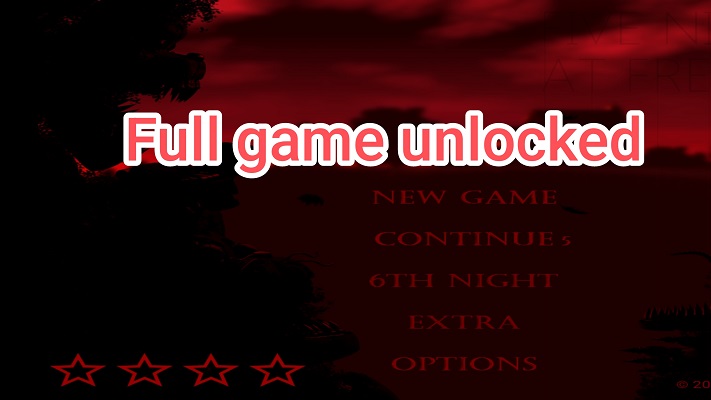
Five Nights at Freddy's 4 shifts the survival horror formula of the series into a more intimate, fear-driven experience by placing the player in the vulnerable role of a child trapped inside a bedroom haunted by twisted animatronic nightmares. Developed by Scott Cawthon and released in 2015 as the fourth main entry, the title departs from previous installments' security office setting and instead forces the player to defend a single room against multiple approaching threats. Gameplay centers on audio cues, careful door management, and moment-to-moment tension: listening for breathing behind doors, flashing a bedside flashlight to check closet and bed, and quickly closing doors when necessary. Unlike prior games that emphasized camera surveillance and resource management across multiple rooms, this entry condenses the experience into a claustrophobic arena where reflexes and auditory perception become the primary tools for survival. The aesthetic design leans heavily into nightmarish reinterpretations of familiar mascots, turning playful animatronics into grotesque, skeletal constructs that embody childhood terror. Horror emerges less from gore and more from anticipation; a single sound or misjudged breath can precipitate a sudden, terrifying jump scare. The structure retains a multiple-night progression with escalating difficulty and hidden Easter eggs, encouraging players to learn patterns and adapt strategies. Mini-games and secret endings are woven into the narrative, offering fragmented pieces of lore that expand the franchise's enigmatic backstory and deepen the sense of mystery. Overall, this installment is noted for its tightened focus, intense atmosphere, and challenging sensory-based gameplay that rewards patience, observation, and quick reactions while delivering a concentrated, psychological approach to animatronic horror that feels distinct within the series. Players often report lasting unease from its minimalistic presentation, and critics praised how a small setting intensifies dread without relying on complex mechanics, making it a memorable, harrowing entry for many fans worldwide.
At its core, the gameplay of Five Nights at Freddy's 4 emphasizes sensory acuity and micro-decisions rather than complex inventories or exploration, creating tension through uncertainty and limited information. Players occupy the role of a child whose primary defenses include two doors, a closet, and a bedside lamp, but every action carries risk and timing is everything. Listening carefully for footsteps, breathing, and other subtle audio cues dictates when to check each doorway or momentarily close a door, and false confidence often results in abrupt failure. The flashlight mechanic is central: shining it briefly down the hallway or at the bed can reveal approaching threats but also leaves openings where creatures might slip in; balancing vigilance and restraint is an ongoing challenge. Animatronics appear with distinct audio signatures and movement patterns that experienced players learn to interpret, while randomized behavior elements keep encounters tense and unpredictable. Visual cues are sometimes available but intentionally limited, forcing reliance on sound design and spatial awareness. Progression through successive nights introduces new animatronic variants, speed changes, and altered frequencies of activity, rewarding players who refine timing and auditory discrimination. Save files contain unlockable mini-games and alternate modes that offer additional context and replayability, and hidden endings require exploration of subtle cues and precise conditions. Difficulty ramps quickly, and success depends on pattern recognition, muscle memory, and a calm response to sudden shocks. Controls are deliberately simple so that focus remains on atmosphere and sensory juggling rather than mechanical complexity. This design results in short, intense play sessions where each decision feels significant, and repeated attempts foster a rhythm of learning that turns terrifying encounters into calculated confrontations as players master the audio-driven rules and adapt their strategies to the game's punishing, immersive ruleset. Sound and silence form the primary language of in-game tension effect.
The narrative of Five Nights at Freddy's 4 unfolds through fragmented vignettes, cryptic mini-games, and visual symbolism that invite players to piece together a gloomy backstory rather than presenting a single straightforward plot. Set primarily in a child’s bedroom, the tale hints at trauma, loss, and fear surrounding animatronic characters that are simultaneously toys and monstrous presences in the protagonist’s psyche. Nightmare versions of classic mascots—distorted renditions that combine elements of other games' antagonists—populate dream sequences and seem to represent guilt, bullying, or real-world threats as perceived by a traumatized child. Hidden scenes reward close attention, offering glimpses of prior incidents and parental reactions that deepen the tragic undertones and raise questions about responsibility and cause. Multiple endings and secret conditions further complicate interpretation, allowing for different readings about identity, timeline, and culpability; whether events are supernatural, psychological, or a hybrid is left intentionally ambiguous. Fans and commentators have mined the game for connective tissue with other series entries, linking recurring motifs and character design choices to create larger theories about the franchise’s timeline and the origins of animatronic malevolence. Subtle audio logs, overheard lines, and seemingly innocuous environmental details contribute to a layered storytelling approach that rewards repeated play and collaborative decoding. The use of a child’s perspective adds emotional weight, juxtaposing innocence with existential dread and making the animatronics feel both familiar and deeply threatening. This approach allows the game to operate on multiple levels: as a pure horror experience and as a piece of interactive storytelling that encourages community speculation and theorycrafting. Ultimately, the story's power lies in what it withholds, leaving players to assemble a mosaic of hints into a personally compelling interpretation. Players continue to debate specifics years after release, sharing discoveries and alternate reconstructions that keep the lore active and evolving across many platforms.
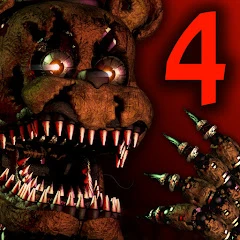
Artistically, Five Nights at Freddy's 4 leans into minimalist set dressing and stark lighting to amplify dread, using a small environment and limited color palette to focus attention on motion, silhouette, and contrast. The bedroom setting is populated with ordinary childhood objects—beds, toys, a night light—that become uncanny when framed against monstrous figures and unsettling audio. Character design favors exaggerated proportions, cracked textures, exposed endoskeleton elements, and unnerving stillness to create instantly memorable antagonists who evoke both nostalgia and revulsion. These visual choices are complemented by a carefully crafted soundscape where ambient noise, creaks, distant music, and increasingly specific creature sounds do much of the psychological work. Silence is used as much as sound, with pauses engineered to prime players for sudden events and to encourage heightened listening. Lighting is functional yet expressive: the flashlight serves as both a tool and a narrative device that reveals selective details and hides others, intensifying uncertainty. The game’s scares rely on timing, misdirection, and the anticipation built over minutes rather than continuous on-screen violence, which makes surprise moments more impactful. Critics admired the way a modest technical presentation yields strong emotional responses, and designers have pointed to this entry as an example of how constraint can breed innovation in horror. The title's aesthetic has influenced subsequent indie horror developers who sought to prioritize mood, sound design, and the manipulation of limited spaces over high-fidelity visuals. Visually iconic, audibly precise, and thematically cohesive, the game's artistic identity demonstrates how deliberate restraint and focused creative decisions can produce a tightly woven, terrifying experience that lingers long after a single play session ends. Because of this concise design, players report intense memory traces of individual scares; the game's imagery and sounds are frequently reproduced in fan art, music remixes, and community storytelling across many platforms worldwide.
Five Nights at Freddy's 4 left a notable mark on horror gaming and fan culture, spawning a vibrant community of theorists, fan artists, modders, and content creators who expanded the game's presence far beyond its original release. Streamers and video creators showcased both skillful playthroughs and reaction content that amplified its reputation for effective jump scares and tense gameplay, while fan fiction and artwork explored the emotional and symbolic layers hinted at by the fragmented narrative. Modding communities experimented with alternate textures, difficulty tweaks, and character reimaginings that allowed players to remix the experience and tailor scares to personal preferences, extending replay value. The game's concise format made it accessible for content creators to produce focused videos and analyses, which in turn fueled discussions about hidden endings, lore connections, and production techniques. Academic and journalistic attention occasionally highlighted the title as an example of minimalist horror design and the psychological effects of sound-driven suspense, contributing to broader conversations about how limited environments can intensify fear. Merchandise, fan projects, and collaborative storytelling projects kept interest alive, and community-driven timelines and compilations helped new players understand recurring motifs across the series. The cultural footprint also includes music remixes, cosplay interpretations, and themed events that celebrate the unsettling aesthetic. While reactions range from admiration for its craft to criticism of its high difficulty and polarizing tone, the overall legacy is one of innovation within constraints: a small team’s focused creative choices produced a game that inspired sustained engagement. For many players, the title operates as both a rite of passage in modern indie horror and a case study in how atmosphere, sound, and design economy can combine to create enduring, emotionally resonant scares that continue to provoke discussion and creative output years later. It remains a touchstone for creators exploring compact, psychological scares.
 HappyMod