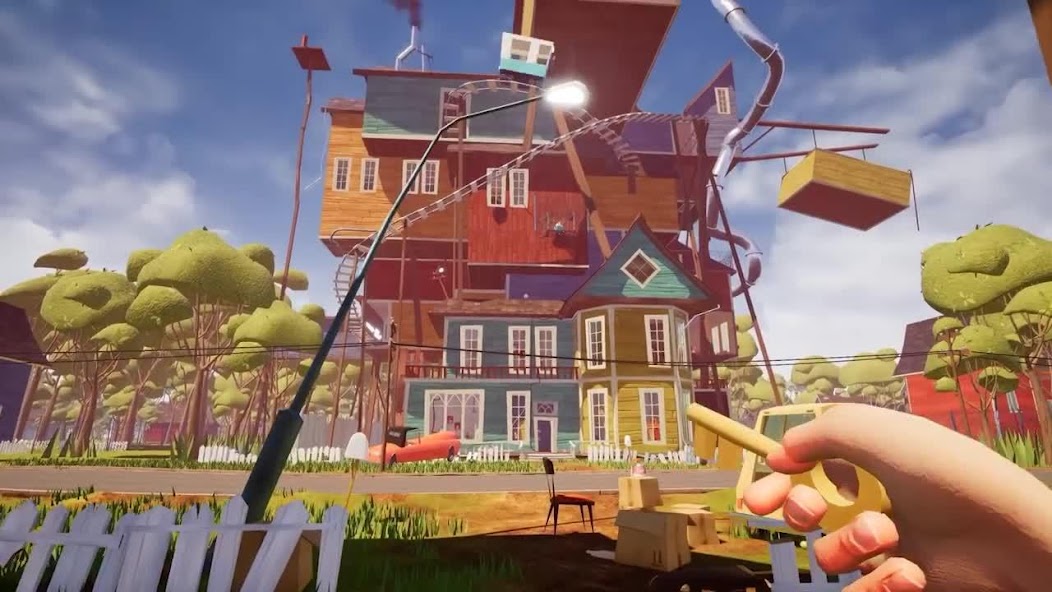
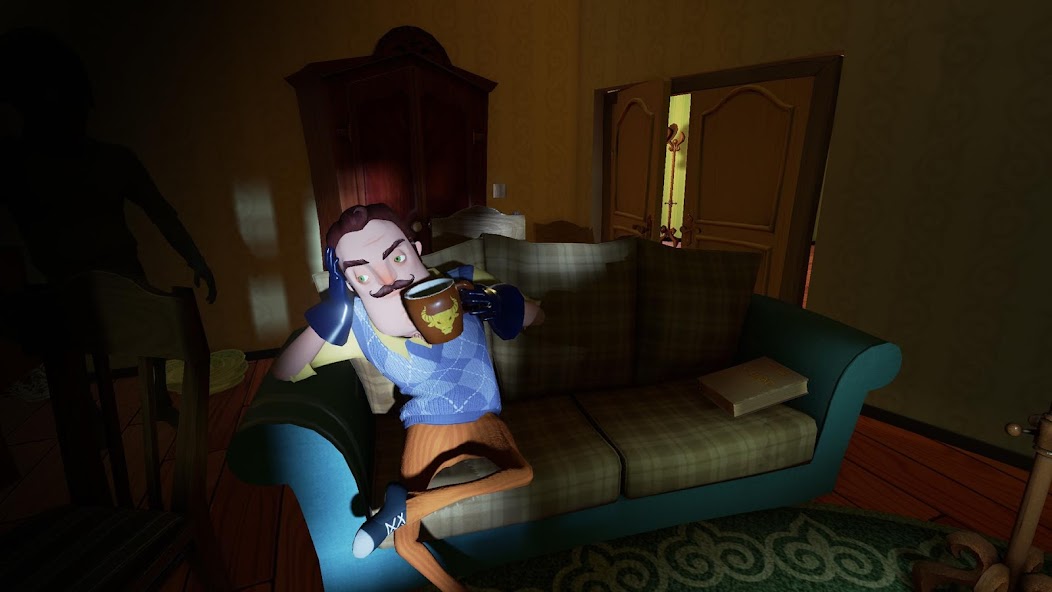
What is Hello Neighbor Games?
Hello Neighbor is a stealth horror game that pits a player against an adaptive AI opponent in a suburban setting. The central premise revolves around a curious protagonist who becomes obsessed with uncovering secrets hidden in a mysterious neighbor’s house. Rather than relying on direct combat or traditional jump scares, the game emphasizes exploration, observation, and clever problem solving. Players must sneak past alarms, avoid patrolling routes, and use a variety of tools and makeshift gadgets to access locked rooms and hidden compartments. The neighbor, controlled by a sophisticated machine learning system, remembers player actions and adjusts his patrols, trap placement, and search patterns accordingly. This creates a dynamic cat-and-mouse experience in which repetition leads to evolving challenges: strategies that worked once will be anticipated and countered in later attempts. Levels are designed with multiple entry points, environmental puzzles, and interactive objects that can be combined in inventive ways. The tension arises naturally from the environment and the neighbor’s unpredictable reactions rather than constant scripted events. Lighting, line of sight, and sound all play crucial roles as players time their movements and create distractions. The game also balances bravery and restraint, offering moments of calm exploration interspersed with intense chase sequences when alarms are triggered or the neighbor grows suspicious. Humor and atmosphere coexist; the neighbor’s exaggerated expressions and odd hobbies add a surreal, uncanny charm that offsets terror with curiosity. Overall, Hello Neighbor offers a unique twist on stealth horror by blending adaptive AI, environmental puzzle solving, and emergent gameplay to create a persistent sense of unease and discovery that rewards experimentation and creative thinking. Players who enjoy observation, iterative planning, and the satisfaction of outsmarting a responsive adversary will find prolonged engagement, as each new tactic invites fresh responses, hidden pathways, and surprising emergent moments to explore further.
At its core, the Hello Neighbor series weaves a narrative that balances family drama, mystery, and surreal allegory. The first game presents a simple premise — a boy’s obsession with uncovering what his neighbor hides in the basement — but layers of implied backstory and environmental storytelling gradually reveal deeper themes. Rooms are staged with personal artifacts, newspaper clippings, and cryptic notes that hint at the neighbor’s past, motivations, and potential secrets. Sequences of dreamlike imagery and sudden tonal shifts suggest that more than a straightforward burglary is at play; the house itself functions like a character, with shifting architecture and hidden passages that mirror the protagonist’s growing fixation. Spin-offs and sequels expand the mythology, moving between timelines and perspectives to explore parental relationships, loss, and the psychology of curiosity. Music cues and fragmented audio logs are used sparingly but effectively to evoke nostalgia or dread, often leaving interpretation up to the player. Much of the series’ narrative power comes from suggestion rather than exposition: players assemble meaning from scattered clues, theories shared by fans, and the emotional texture of encounters. This encourages active engagement with the story; moments spent cataloging strange items or revisiting a room under new conditions often unlock fresh readings of earlier events. While some installments embrace lighter, even comedic tones, others double down on unsettling surrealism, using bright colors and warped proportions to unsettle expectations. The result is a franchise that resists simple classification, combining elements of home-invasion thrillers, psychological horror, and adventure games. For players who appreciate narrative ambiguity and playful worldbuilding, Hello Neighbor offers a layered experience where each discovery invites questions, and every secret uncovered reframes the motives and memories embedded within the house. Fans often theorize about character motivations, trade interpretations, and create fanworks that extend the story with imaginative variations.
Mechanically, Hello Neighbor is known for its adaptive artificial intelligence and level design that encourages creative problem solving. The neighbor’s behavior model tracks player actions across attempts and adjusts curiosity levels, search strategies, and environmental changes to counter repeated approaches. This system rewards varied thinking: players who always use the same window or disrupt the same pattern will notice the environment adapting, prompting experimentation with decoys, timing, and object placement. Puzzle design favors emergent solutions rather than single scripted answers; household items become tools, distractions, or keys when combined in unconventional ways. Doors can be locked, safes require codes or hidden keys, and physics-based interactions allow players to stack boxes, move furniture, or construct improvised paths. Stealth mechanics emphasize line of sight and sound propagation: running, dropping objects, or breaking glass increases detection risk while sneaking and using cover reduces it. The game includes a learning curve where early failures teach players how the neighbor perceives threats, and those lessons can be used to engineer clever diversions such as creating noise in a distant room or manipulating lighting to obscure movement. Level layouts are often layered with verticality, secret passages, and interconnected rooms that reward exploration and memory. Later episodes expand the toolset and introduce scripted setpieces that complement, rather than replace, emergent gameplay. Developers balanced challenge by tuning detection radii, reaction times, and the complexity of environmental locks to create a steady progression of difficulty. For players interested in systems-driven design, Hello Neighbor offers a compact laboratory of cause-and-effect, inviting players to test hypotheses about AI thresholds, timing windows, and how the game’s mechanics can be bent through unconventional use of found objects. Modders and curious players often document tricks, optimization techniques, and inventive sequence breaks that highlight how flexible emergent systems can produce surprising, reproducible outcomes over time.
Hello Neighbor’s aesthetic choices and audio design play a major role in shaping player emotion and interpretation. Visually, the series opts for stylized, slightly cartoonish character models and environments that contrast with darker themes, producing an uncanny atmosphere where bright colors and exaggerated proportions feel simultaneously familiar and off-kilter. Architectural exaggerations—from impossibly angled staircases to hidden rooms with shifting geometry—enhance the sense that the house is a living puzzle. Lighting design helps to modulate tension: warm, domestic lamps can lull a player into complacency while sudden shadows or flickering bulbs cue imminent danger. Sound design is both functional and atmospheric; subtle ambient noises, creaks, muffled radio broadcasts, and distant footsteps inform players about unseen activity and heighten suspense. The neighbor’s vocalizations and musical motifs punctuate chase sequences and moments of discovery, with tempo and instrumentation changing to influence perceived threat levels. Technically, the games run on engines tuned to support dynamic object interaction, physics stacking, and AI state changes at runtime. Performance considerations required developers to balance interactivity with stability, leading to optimizations for pathfinding, collision detection, and event scripting. Many levels are constructed from modular pieces that allow designers to rearrange spaces while maintaining consistent gameplay rules. Art direction often foregrounds readable silhouettes and interactive affordances so players can quickly identify objects that might be useful for solving puzzles. In addition, the juxtaposition of whimsical props and eerie set dressing reinforces the series’ tonal unpredictability: household items can be harmless or instrumental in a tense escape. Altogether, art and sound work in concert with systems design to guide player focus, amplify emotional beats, and make each exploration feel rich and distinct despite recurring mechanical themes. Subtle implementation details like object weight, friction, and ragdoll response contribute to believable interactions, so small gestures often cascade into dramatic, memorable gameplay moments.
Hello Neighbor evolved beyond a single release into a franchise that sparked varied creative responses across players, modders, and streaming communities. The original concept proved fertile for reinterpretation, spawning sequels, spin-offs, and multiplayer experiments that reimagined neighbor dynamics in cooperative or asymmetric formats. One notable branch explored multiplayer social deception by casting one player as the suspicious householder while others attempt cooperative infiltration, which altered both pacing and psychological tension. Community creativity manifested in fan-made levels, machinima, fan art, and walkthrough repositories that documented clever solutions and hidden secrets. Content creators embraced the game’s emergent moments for live streams and highlight reels, where unexpected AI behavior or player improvisation often created viral clips. From a business perspective, the franchise demonstrated how a distinctive hook—adaptive AI in a familiar domestic setting—can be developed into diverse products that appeal to different audiences, including players drawn to narrative puzzling and those attracted to social play. The series also prompted discussions around design ethics; its portrayal of home invasion scenarios raised questions about tone, player agency, and how humor can be balanced against horror. Educationally, designers and students have analyzed Hello Neighbor as a case study in emergent AI behavior, iterative testing, and modular level composition. Modding tools and developer commentary, when shared, helped some community members learn about game construction and systems tuning. Collectively, these interactions cultivated a participatory culture where fans not only consumed content but also contributed to the franchise’s evolving identity. As a result, Hello Neighbor stands as an example of how a compact gameplay premise can seed a broader ecosystem of adaptations, analyses, and shared creative output that extend the life and relevance of the original idea. Future conversations about the franchise consider accessibility, narrative expansion, and how to preserve emergent surprises while scaling for platforms and player expectations.
 HappyMod