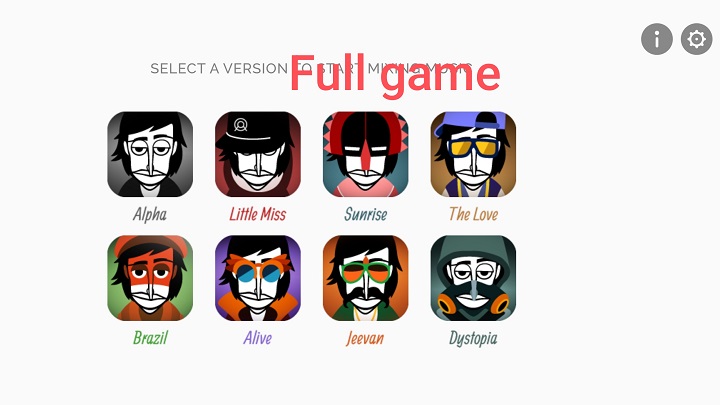
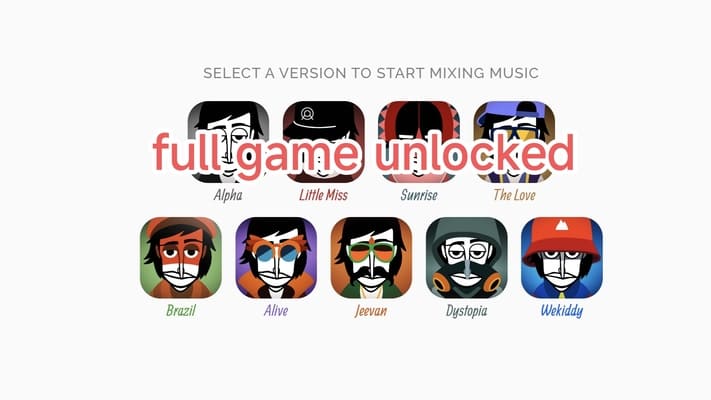
What is Incredibox Games?
Incredibox is a playful music creation game that invites users to become beatmakers by arranging animated characters that produce vocal loops, percussion sounds, and melodic fragments. Players drag icons onto avatars to assign roles such as beatbox, bass, melody, effects, and choir, building layered tracks that groove together. The interface is deliberately minimal: a stylized street scene populated by characters whose faces and movements change to reflect the sounds they generate. Starting with a blank set of performers, users experiment with combinations, listen for surprising harmonies and rhythmic interactions, and discover short sequences called "combos" that trigger special musical transitions. Each version of the game offers a distinct sonic palette and aesthetic theme, from vintage hip-hop and soul to electronic textures and choral arrangements, giving creators a varied toolkit. The gameplay rewards curiosity and listening skills rather than technical knowledge, so people without prior musical training can quickly produce satisfying results. Because elements loop and synchronize automatically, users concentrate on arrangement and timbre instead of timing minutiae. In addition to ad hoc jamming, Incredibox encourages iterative refinement: players often mute, swap, or reorder characters to emphasize different layers, sculpting dynamics and tension across a piece. The result can be anything from a short rhythmic sketch to a polished short composition, depending on how much time and attention someone dedicates. Visual feedback, such as animated lights and character expressions, reinforces musical changes and helps guide creative decisions. Overall, Incredibox blends playful visuals, simple controls, and immediate audio gratification to make music composition accessible, addictive, and entertaining for a broad audience. It can be used in casual social settings, classrooms, or personal practice to spark experimentation, invite collaborative play, and illustrate principles of rhythm, layering, and timbre without overwhelming beginners with technical complexity while remaining entertaining and instantly gratifying for many listeners.
Incredibox’s gameplay centers on an elegant interaction model that reduces music production to a few intuitive gestures. Players are presented with a row of blank avatars representing vocalists and instrumental roles, and a palette of icons that correspond to rhythm patterns, melodic loops, sound effects, and processing units. Dragging an icon onto a character instantly assigns that sound to an automatic loop, and stacking different icons across slots creates polyphonic arrangements and call‑and‑response patterns. Timing and tempo are managed behind the scenes by a synchronization engine, so loops lock in phase and remain rhythmically aligned as more elements are added. As combinations form, short audio rewards called combos light up, often altering the texture or triggering transitional phrases that propel a mix forward. Many versions include a scoring or progress indicator that encourages discovery of all available combos, turning experimentation into a playful objective without imposing strict constraints. A record function lets users capture their sessions in real time, after which they can play back their piece from start to finish and listen for details they might want to change. Visual animation and subtle haptic feedback underscore the cause‑and‑effect relationship between actions and sounds, helping novices learn by ear. The game also supports layering of effects such as reverb, delay, or distortion, which can color individual parts and change the overall mix dramatically. Designers often balance the sonic palette so that random combinations still sound musically coherent, enabling delightful accidents that feel intentional. Because the interface abstracts away technical jargon and offers immediate audible results, Incredibox becomes both a compositional sandbox and a rhythmic puzzle, inviting repeated play as users chase satisfying progressions, rare combos, and polished miniature compositions. It scales well for quick sessions or longer creative bouts, welcoming improvisation while revealing patterns that reward deeper exploration.
Incredibox fosters a creative ecosystem where playful experimentation and community appreciation feed one another. Because every session can be recorded, players generate a continual stream of short musical pieces that serve as creative snapshots: loops, grooves, vignettes, and surprising mashups that highlight idiosyncratic choices. Users enjoy tweaking instruments, hunting for elusive combos, and remixing past ideas into fresh arrangements, which creates a culture of iterative variation. Many fans exchange links and recorded files to show favorite mixes, compare approaches, and inspire one another with unconventional pairings. This exchange emphasizes the performative aspect of the app: mixes can function as short performances or audio postcards, curated for mood, humor, or technical cleverness. The game’s simple visual language and character-driven presentation make it easy to frame results as shareable artifacts, and the compact duration of most creations encourages bite-sized consumption and rapid feedback cycles. Additionally, casual competitions and friendly challenges often spring up informally, such as who can unlock rare combos fastest, craft the most unexpected harmonic blend, or create a mix that transitions smoothly between distinct moods. Such practices make Incredibox a social instrument without requiring complex technical skills. Creators also use the tool to prototype ideas or sketch melodic motifs that later inform larger musical projects; the immediacy of looped playback accelerates decision-making and helps collaborators stay aligned on rhythmic choices. Visuals and simple labels keep the focus on auditory outcomes, so community conversations center on texture, timing, and arrangement rather than on production jargon. Over time, a shared vocabulary develops around particular versions, signature sounds, and favored techniques, which both guides newcomers and rewards long-term players who recognize subtle possibilities. The net result is an active, playful scene where solitary composition and communal appreciation enhance each other, turning short digital experiments into memorable musical moments. Accessible, joyful, endlessly replayable.
Incredibox offers strong educational value by turning abstract musical concepts into tangible, playable elements that learners can manipulate directly. The app’s loop-based structure teaches the basics of rhythm, tempo, layering, and form through hands-on experimentation: adding a bass line reveals how low frequencies anchor a groove, inserting a percussive element highlights subdivision and syncopation, and layering harmonies demonstrates how timbre and interval choices affect consonance and dissonance. Because each vocal or instrumental slot represents a discrete sonic function, educators can use the tool to illustrate roles in an ensemble—lead, rhythm, bass, and texture—without requiring students to read notation or master an instrument. The immediate audible outcome reinforces aural skills, encouraging attentive listening, comparison of timbral differences, and iterative refinement. For younger learners, the colorful characters and instant gratification foster engagement and motivation, while older students can explore arrangement strategies, dynamics, and contrast. Accessibility features such as simple drag-and-drop controls, clear visual feedback, and predictable loop synchronization lower the barrier for users with limited motor control or those new to music technology. The game also supports differentiated learning: novices can focus on discovery and play, while more advanced students can treat it as a compositional sketchpad to experiment with texture, counterpoint, or thematic development. Because creations are compact and loop-based, they fit neatly into short classroom activities or longer project-based lessons, enabling scaffolded exploration over multiple sessions. Teachers often find the predictable structure valuable for introducing improvisation and collaborative decision-making, since groups can assign roles, agree on changes, and iteratively improve a shared mix. Finally, the playful presentation reframes music theory as an applied, enjoyable practice rather than an abstract obligation, helping learners build confidence and curiosity that can transfer to other musical pursuits. It supports exploratory assessment, formative feedback, and creative portfolios for classrooms focused on experiential learning, and reflection.
On a technical and design level, Incredibox balances simplicity with depth through careful curation of sounds, tight synchronization, and expressive visual feedback. Each release is effectively a compact instrument built from a fixed palette of loops and effects, with audio assets crafted to combine harmoniously from the outset. The runtime mixes short, precomposed loops with generative sequencing rules so that when icons are assigned they trigger musically compatible phrases that mesh in tempo and key. This hybrid approach reduces user friction while still allowing emergent complexity as multiple parts interact. Animations, color coding, and subtle particle effects give immediate cues about energy, intensity, and transitions, reinforcing musical intuition with visual storytelling. Sound designers typically tune volume, EQ, and stereo placement so that new layers add interest without masking foundational parts, enabling balanced mixes even when users select unlikely combinations. The codebase prioritizes low latency and efficient looping to keep playback responsive across a variety of devices, and careful asset compression preserves clarity while minimizing download size. Over time, the project has evolved through different thematic editions, each showcasing unique production styles and sometimes incorporating guest artists or stylistic references that expand the creative palette. The interface remains consistent across editions to preserve learnability, while aesthetic changes refresh the experience and invite new exploration. From a product perspective, Incredibox demonstrates how constraint-driven tools can stimulate creativity: by limiting options thoughtfully, designers encourage deeper engagement with the possibilities that remain. The result is a polished, resilient musical toy that supports quick, delightful composition, continuous discovery, and repeated replay without overwhelming the user with unnecessary knobs, menus, or technical choices. It serves as both a casual pastime and a creative sketch tool for composers and producers who value immediacy, playful experimentation, and the constrained alchemy that often yields surprising musical ideas and joy.
 HappyMod